
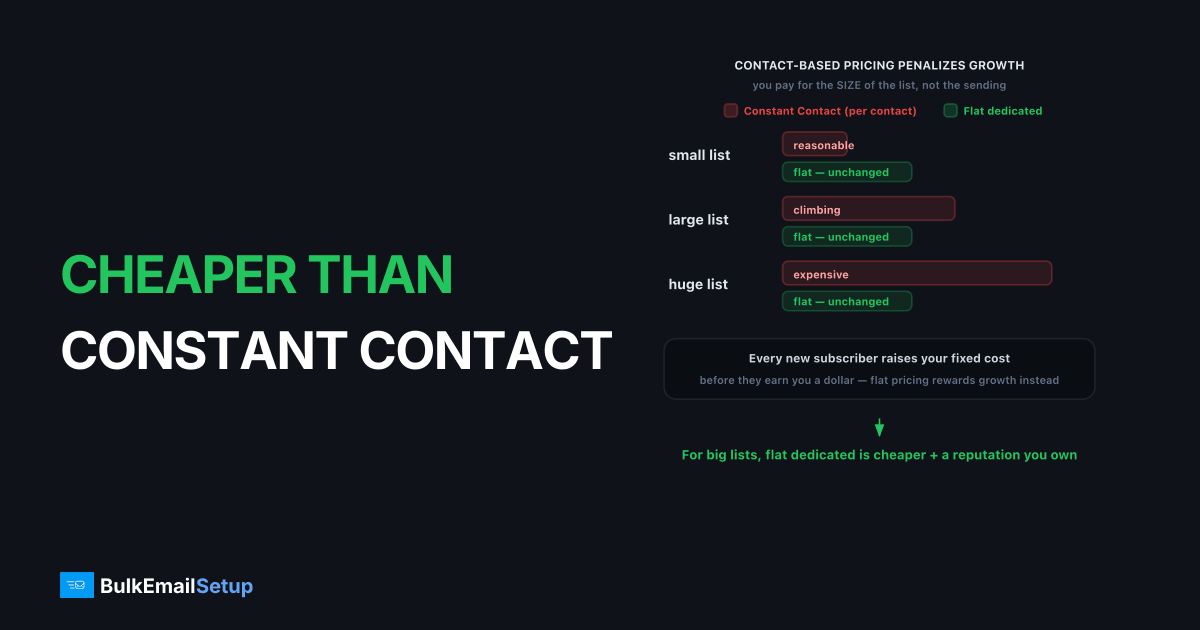
A cheaper alternative to Constant Contact for high-volume bulk email is a flat-rate dedicated SMTP server. Constant Contact prices by contact count, so your bill rises as your subscriber list grows, even if you mail those contacts infrequently. That model punishes large lists. A flat dedicated plan charges for sending capacity, not contacts, so a big list doesn't inflate the cost the same way. For high-volume senders, the dedicated route is usually cheaper and adds a reputation you control. For small-business newsletters, Constant Contact's all-in-one convenience may still be worth the premium.
Why is Constant Contact expensive for large lists?
Constant Contact is expensive for large lists because its pricing is contact-based: the more subscribers you store, the more you pay, regardless of how often you actually email them. A list that grows into the tens or hundreds of thousands drives the bill up even when send volume is modest.
That's the structural mismatch for bulk senders. You're charged for the size of your audience, not the work of delivering to them. A flat-rate dedicated SMTP plan charges for capacity instead, so a large, infrequently-mailed list costs you nothing extra to hold.
Contact-based pricing quietly penalizes list growth, which is the opposite of what a growing sender wants. Every new subscriber raises your fixed cost before they've generated a dollar. Capacity-based flat pricing rewards the same growth, because more contacts on a flat plan just means a lower effective cost per email.
How does the cost compare at scale?
For small lists Constant Contact's bundled tools can be worth the price; for large lists and high send volume, a flat dedicated SMTP plan usually wins on cost. The crossover depends on your list size and tier. These are illustrative ranges as of early 2026, not exact quotes.
| Your situation | Constant Contact | Flat dedicated SMTP |
|---|---|---|
| Small list, light sending | bundled tools, reasonable | flat plan, likely overkill |
| Large list, moderate volume | contact-based, climbing | flat, usually cheaper |
| Large list, high volume | expensive | flat, clearly cheaper |
| Need a dedicated IP you control | not the core model | yes |
We've seen senders with large, slow-growing lists pay Constant Contact for storage they barely used, because the price scaled with contacts rather than activity. One we moved had crossed into a higher contact bracket purely from list growth, while their actual send volume hadn't changed in months, so they were paying a step more each quarter to mail the same campaign. Moving to capacity-based pricing decoupled the bill from list size entirely, and the next 40K subscribers they added cost nothing extra to hold. The general cost pattern is in cost per email - dedicated SMTP vs ESP.
Constant Contact uses contact-based pricing, so cost rises with subscriber count even when send frequency is low (provider pricing pages, early 2026). For high-volume bulk senders, a flat-rate dedicated SMTP server charges for capacity rather than contacts, so large lists do not inflate the bill the way contact-based pricing does.
What do you gain by switching to dedicated SMTP?
You gain a dedicated IP you control, full SMTP access, and a cost that's decoupled from list size. Constant Contact is an all-in-one marketing tool; a dedicated SMTP server is sending infrastructure you own, which is what high-volume senders actually need.
What the dedicated route adds:
- A reputation you own, isolated from other senders. See dedicated IP vs shared IP for email.
- Capacity-based cost, not contact-based, so list growth doesn't raise your bill.
- Full SMTP access, connect any sending tool, CRM, or app.
- Correct authentication, SPF, DKIM, DMARC, and PTR set up right. See SPF vs DKIM vs DMARC.
The honest trade-off: Constant Contact bundles list management, templates, and campaign tools that a raw SMTP server doesn't. If you rely on those built-in marketing features, switching means sourcing them elsewhere. And a dedicated IP needs a 4 to 6 week warm-up plus consistent volume to hold its reputation.
Does switching improve deliverability?
Not by itself. Deliverability depends on list hygiene, authentication, complaint rates, and a warmed IP, not on the provider's logo. A dedicated IP gives you control of those levers, which helps senders with good practices and exposes senders with bad ones.
The fair framing: if your lists are clean and your complaint rate is low, a dedicated IP lets you build a reputation no one else can damage. If they aren't, switching just means you own the blocklist hits yourself. For a parallel comparison, see a cheaper alternative to Sendinblue.
Who should stay on Constant Contact?
Stay on Constant Contact if you're a small business that values the bundled tools more than the per-contact cost, with a modest list and no in-house technical resources. Its built-in templates, contact management, and event tools are genuinely useful for a marketer who doesn't want to assemble a stack. The premium buys simplicity.
You should stay if most of these are true:
- Your list is small and growing slowly.
- You rely on the built-in campaign builder and templates.
- You don't have technical staff to manage sending infrastructure.
- Your send volume is low enough that contact-based pricing isn't biting yet.
The clearest signal that you've outgrown Constant Contact is when your bill is driven by contacts you mail rarely. At that point you're paying for storage and bundled features, not for delivery, and a capacity-based flat plan separates those costs. Senders who notice this are almost always past the volume where dedicated infrastructure pays off.
How do you replace Constant Contact's bundled features?
Replace the bundled features by pairing a dedicated SMTP server with a sending application you control: an open-source or self-hosted mailer for campaigns and lists, plus the SMTP server for delivery. The SMTP server handles authentication, the dedicated IP, and deliverability; your chosen front end handles templates and contacts.
A common replacement stack:
- Dedicated SMTP server for delivery, the dedicated IP, and authentication.
- A self-hosted or open-source mailer for list management and campaign building.
- Correct authentication wired in: SPF, DKIM, DMARC, and PTR. See SPF vs DKIM vs DMARC.
- Clean list practices, since you now own deliverability outcomes.
The honest part: this stack is more powerful and cheaper at volume, but it's more setup than an all-in-one tool. If assembling and maintaining it sounds like more than you want, a managed dedicated SMTP server removes the infrastructure half while you keep your preferred front end.
What does the cost gap look like as a list grows?
The contact-based penalty is clearest when you watch one list grow. Constant Contact's bill climbs with every subscriber tier you cross, whether or not you mail more. A flat capacity plan doesn't move at all as the list grows, so the gap between the two widens at exactly the points contact-based pricing bumps you up a bracket.
| List size | Constant Contact (contact-based) | Flat dedicated SMTP | Effect on flat cost per email |
|---|---|---|---|
| 5K contacts | low tier, cheapest | flat plan, likely overkill | high |
| 25K contacts | climbing | same flat plan | falling |
| 100K contacts | noticeably higher | same flat plan | lower |
| 250K+ contacts | expensive bracket | same flat plan | lowest |
The flat column is one number down every row. Contact-based pricing isn't, it steps up each time your subscriber count crosses a threshold, even in a month you barely sent. A large, slow-growing list is the worst case for contact pricing and a non-event for capacity pricing.
The cruel part of contact-based pricing is that it bills you for potential sending, not actual sending. Every dormant subscriber you keep "in case" costs money before they open anything. Capacity pricing flips that: holding a big list is free, and you only think about cost when you actually send. For senders sitting on large lists they mail occasionally, that difference alone can justify the move. The general pattern is in cost per email - dedicated SMTP vs ESP.
Before you switch, export your list and check what share is genuinely active. If half your contacts haven't opened in six months, you're paying Constant Contact to store dead weight. On capacity pricing that same list costs nothing to hold, so the move pays off fastest for senders with large, lightly-engaged audiences.
How BulkEmailSetup helps
If Constant Contact's contact-based pricing has made your large list expensive to hold, a flat-rate dedicated SMTP server decouples cost from list size: one fixed monthly fee, a dedicated IP you control, full SMTP access, and SPF, DKIM, DMARC, and PTR configured correctly. We handle warm-up and reputation monitoring. See plans on our pricing page.
Frequently asked questions
What is a cheaper alternative to Constant Contact?
For high-volume bulk email, a flat-rate dedicated SMTP server is usually cheaper than Constant Contact, whose pricing rises with your contact count. Above a large list size or high send volume, flat infrastructure pricing typically wins on effective cost per email.
Why is Constant Contact expensive for large lists?
Because its pricing is contact-based: your bill rises as your subscriber count grows, even if you mail them infrequently. A flat-rate dedicated SMTP plan charges for capacity, not contacts, so a large list doesn't inflate the cost the same way.
Is Constant Contact good for bulk email at volume?
It's built more for small-business marketing than high-volume bulk sending. As lists and send volume grow, contact-based pricing becomes costly and you don't get a dedicated IP you control. High-volume senders usually outgrow it on both cost and control.
Does switching from Constant Contact improve deliverability?
Only if you send well. A dedicated SMTP server gives you a dedicated IP and reputation control Constant Contact doesn't, but deliverability still depends on your list hygiene, authentication, and complaint rate. The switch helps senders with good practices most.


