
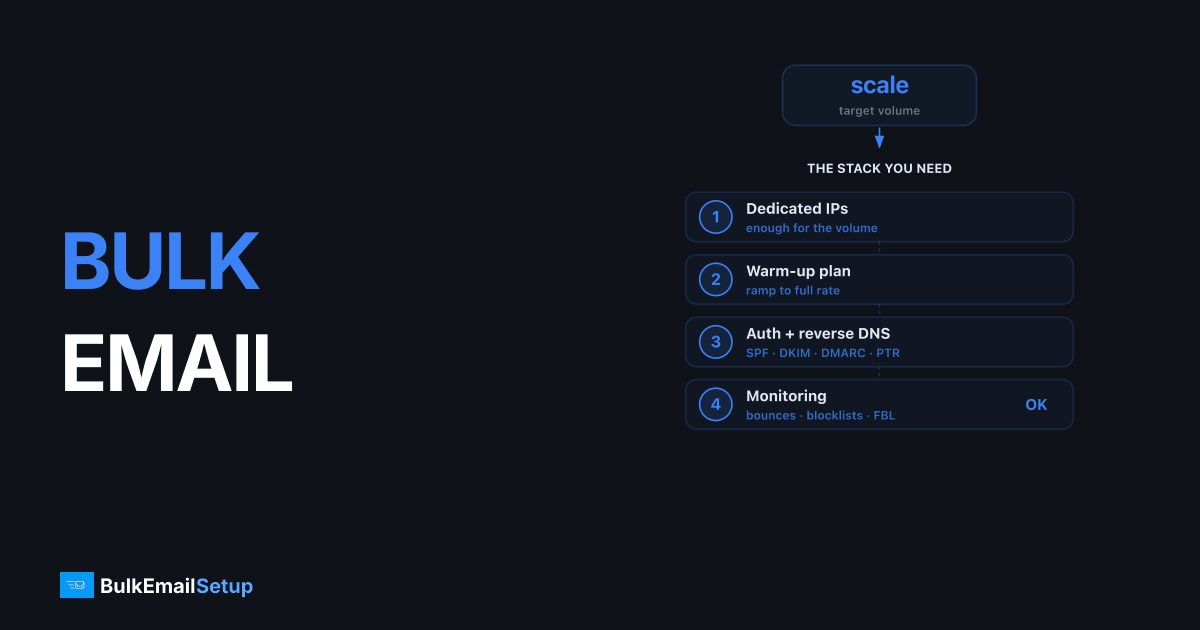
Bulk email hosting is server infrastructure built to send high volumes of outbound email, normally an SMTP server with dedicated IP addresses, full authentication (SPF, DKIM, DMARC, PTR), and no per-message send caps. It is not mailbox hosting, which receives and stores your mail, and it is definitely not web hosting, which serves your website. Mixing these up is the single most common reason bulk email campaigns fail before they start.
Bulk email hosting vs the hosting you already have
Most people try to send bulk email from hosting they already pay for, then wonder why delivery collapses at a few hundred messages.
| Factor | Web hosting | Mailbox hosting | Bulk email hosting |
|---|---|---|---|
| Built for | Serving web pages | Receiving your mail | Sending at volume |
| Port 25 outbound | Usually blocked | Relay only | Open, fully controlled |
| Daily send limit | ~200-500 | ~2,000 per account | 25,000-200,000+ |
| IP reputation | Shared with strangers | Shared pool | Dedicated to you |
| Authentication control | Minimal | Provider-managed | Full (SPF/DKIM/DMARC/PTR) |
| Bounce handling | None | Basic | Built in |
The row that matters most is IP reputation. On shared web hosting your mail leaves from an IP used by hundreds of other sites. When one of them sends spam, that IP gets blocklisted, and your invoices and campaigns get blocked alongside it. You have no control and no visibility.
Shared vs dedicated bulk email hosting
Once you are on real email hosting, the next decision is whether your sending IPs are yours alone.
SHARED IP POOL                    DEDICATED IPs
┌───────────────────┐            ┌───────────────────┐
│ you  ▓            │            │                   │
│ sender B ▓▓▓      │            │   only you  ▓▓▓   │
│ sender C ▓ (spam) │            │                   │
└─────────┬─────────┘            └─────────┬─────────┘
          │                                │
    one bad sender                   your reputation
    blocks everyone            rises and falls on your
                                    behavior alone
Shared makes sense below roughly 50,000 emails/month, when the provider's pool reputation is better than anything you could build alone, and you would rather not manage warm-up.
Dedicated makes sense above that, when email drives revenue, or when you send cold email that most shared providers prohibit outright. The tradeoff is that a dedicated IP starts with no reputation at all and must be warmed over 4-6 weeks.
What proper bulk email hosting includes
Anything calling itself bulk email hosting should give you all of these. If it does not, you are buying web hosting with a mail server bolted on.
- Dedicated IP addresses with reverse DNS (PTR) records you control. Missing PTR alone sends mail straight to junk at Microsoft.
- Full authentication, meaning SPF, DKIM, and DMARC you configure per sending domain. See SPF, DKIM and DMARC setup for the records themselves.
- A real MTA (PowerMTA, Postfix, or similar) with queue control, retry logic, and throttling per receiving domain.
- Bounce and complaint processing, including feedback loops with the major mailbox providers so complaints suppress automatically.
- Warm-up capability, since new IPs need a graduated ramp. Our IP warm-up schedule covers the timeline.
- No contact limits or per-email fees, which is normally the whole reason to leave an ESP.
How much throughput you actually need
Sizing bulk email hosting is about IP count and warm-up status, not CPU. A modest server pushes far more mail than most people expect, provided the IPs are warmed.
| Monthly volume | Rough setup | Realistic daily ceiling |
|---|---|---|
| Under 50,000 | Shared pool or 1 IP | ~2,000/day |
| 50,000 - 500,000 | 1 server, 3 dedicated IPs | ~25,000/day |
| 500,000 - 5 million | 3 servers, 15 dedicated IPs | ~200,000/day |
| 5 million+ | Multi-server with rotation | 500,000+/day |
Adding IPs raises the ceiling; adding RAM does not. A single unwarmed IP trying to push 25,000 messages on day one gets throttled or blocked no matter what hardware sits behind it.
Self-managed or managed?
| Factor | Self-managed VPS | Managed hosting | Owned + set up for you |
|---|---|---|---|
| Upfront | Low | None | One-time fee |
| Monthly | $5-40 + IPs | Flat recurring | Server cost only |
| Warm-up | You do it | Included | Done for you |
| Blocklist handling | You do it | Included | Guided |
| You own the stack | Yes | No | Yes |
The middle column is the comfortable choice, but you are renting forever and you do not own the infrastructure. If the provider changes policy or price, you migrate and re-warm from scratch. For a full price comparison see how much a dedicated SMTP server costs.
Mistakes that get bulk email hosting blocked
- Sending from unwarmed IPs. The most common failure. Ramp over 4-6 weeks, never jump to full volume.
- No PTR record. Microsoft and others reject or junk mail from IPs without matching reverse DNS.
- One IP for every mail type. Keep transactional, marketing, and cold email on separate IPs so a complaint spike in one does not sink the others.
- Ignoring bounces. Repeatedly mailing dead addresses is the fastest way to look like a spammer. Suppress hard bounces immediately.
- Buying a "cheap SMTP" from a reseller. Those IPs usually carry history you cannot see. Check any IP against blocklists before you send a single message.
How BulkEmailSetup helps
We build bulk email hosting you own outright: a dedicated SMTP server with your own IPs, full SPF/DKIM/DMARC/PTR configuration, MTA tuning, bounce handling, and a warm-up plan, set up as a one-time job rather than a monthly rental.
Basic starts at $549 one-time, covering 1 SMTP server, 3 dedicated IPs, 25,000 emails/day, and unlimited contacts. Higher volumes scale to 15 IPs and 200,000 emails/day. See pricing for the full breakdown, or compare the best dedicated SMTP providers first if you are still weighing managed options.
Frequently asked questions
What is bulk email hosting?
Bulk email hosting is server infrastructure built specifically to send large volumes of outbound email, typically an SMTP server with its own dedicated IP addresses, proper authentication, and no per-message send caps. It is different from mailbox hosting, which stores and receives your email, and from web hosting, which serves your website.
Can I send bulk email from regular web hosting?
No, not reliably. Shared web hosting blocks port 25, caps outbound mail at a few hundred messages a day, and puts you on an IP shared with hundreds of other sites. One spammer on that IP gets your mail blocked too. Web hosting is built to serve pages, not to send mail at volume.
What is the difference between shared and dedicated bulk email hosting?
Shared hosting puts your mail on IP addresses used by many senders, so another sender's complaints can damage your delivery. Dedicated hosting assigns IPs exclusively to you, meaning your sender reputation is entirely your own, which matters most above roughly 50,000 emails a month.
How much does bulk email hosting cost?
Self-managed VPS hosting runs roughly $5-40/month plus $2-10/month per dedicated IP. Managed bulk email hosting bundles the server, IPs, warm-up, and monitoring into a flat fee. A one-time setup on infrastructure you own starts at $549 and avoids recurring per-email charges entirely.
How many emails can a bulk email hosting server send per day?
A single well-configured server with 3 dedicated IPs handles around 25,000 emails a day comfortably. Throughput scales with IP count and warm-up status, not raw server power, so a fully warmed 15-IP setup can push 200,000 a day while the same hardware unwarmed would get throttled.


