
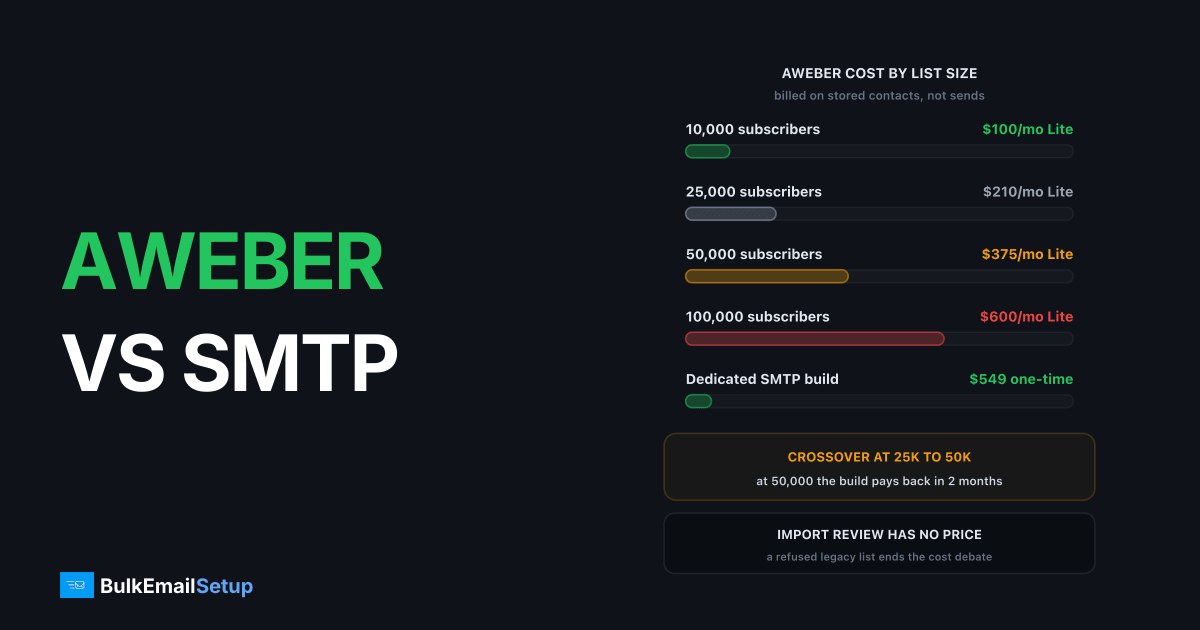
AWeber costs $100 a month at 10,000 subscribers and $600 a month at 100,000, billed on stored contacts rather than emails sent. It has been running since 1998 and its deliverability reputation comes from curation: strict import rules, a human reviewing large uploads, and fast action on complaint rates. That is genuinely valuable if your list is small and clean. It is a wall if you are carrying a five-year-old list you want to reactivate.
So the real question is not "which is cheaper". It is whether your list is the kind AWeber wants.
The import review nobody warns you about
Load a fresh 800-address export and nothing happens. Load 40,000 addresses collected between 2019 and 2022 and you get a review.
AWeber's pricing and plan terms sit on top of an anti-spam policy that requires permission-based lists only. In practice the checks look like this:
| Import scenario | What usually happens |
|---|---|
| Under ~1,000 addresses, recent signups | Goes straight through |
| 5,000+ addresses, no source given | Held, you get asked where they came from |
| Purchased, rented or scraped list | Refused outright, account flagged |
| List last mailed 3+ years ago | Reviewed, often trimmed to engaged only |
| Co-registration or lead-gen data | Usually refused |
| Re-import after an opt-out purge | Fine, and expected |
The questions you get asked are consistent: where did these addresses come from, what did the signup form say, when did they last receive mail from you, and can you show the opt-in record. If you cannot answer the last one for most of the list, expect a refusal.
None of this is unreasonable. AWeber is protecting a shared IP pool that thousands of other senders depend on. But it means the decision is not yours, and that is the thing operators find hardest.
What happens to a five-year-old list
This is the scenario that sends people looking for alternatives, so let me be concrete about both paths.
| Stage | On AWeber | On your own IPs |
|---|---|---|
| Import | Reviewed, may be refused | No gatekeeper, you decide |
| First send | Full list if approved | Engaged 10-20% only, by choice |
| Bounce spike | Counts against your account | Costs you, teaches you |
| Complaint spike | Risk of suspension | Damages IPs you own |
| Reactivation over months | Hard, review sits on top | Normal practice, you control pace |
| Recovery from a bad send | Appeal, wait, possibly banned | Warm up again, no third party |
A five-year-old list is not one list. It is usually an engaged 15 to 25%, a dormant-but-valid 40%, and a dead 30 to 45% that will bounce or complain. Mail all of it at once anywhere and you get a 12 to 20% bounce rate and a complaint rate well past Gmail's 0.3% line.
The difference is what the failure costs. On AWeber that send can end your account, and you lose the platform and the list export window along with it. On your own infrastructure it burns IPs you paid for and you spend six weeks rebuilding reputation. Both are bad. One is recoverable without asking permission.
Clean the list before either path. Email list cleaning is the highest-return hour you will spend, and on AWeber it also drops your bill.
What AWeber charges
Prices from AWeber's own page, monthly billing, at the subscriber counts people actually sit at.
| Subscribers | Lite | Plus | Annual cost on Lite |
|---|---|---|---|
| 500 | $15/mo | $30/mo | $180 |
| 2,500 | $35/mo | $55/mo | $420 |
| 10,000 | $100/mo | $135/mo | $1,200 |
| 25,000 | $210/mo | $250/mo | $2,520 |
| 50,000 | $375/mo | $400/mo | $4,500 |
| 100,000 | $600/mo | $750/mo | $7,200 |
Lite caps you at 3 landing pages, 3 automations and 1 custom segment, and keeps AWeber branding on your emails. Plus removes all four limits. If you run more than three automations, and most people past 10,000 subscribers do, you are on Plus pricing, not Lite.
The unsubscribed-contact problem
Here is the part worth checking on your own account, because AWeber does not spell it out on the pricing page. On per-subscriber platforms generally, unsubscribed and inactive records stay on the account and count toward the tier you are billed at. Archiving is not deleting. Compare your billed subscriber count against your active count before assuming otherwise.
| List state | Billable count | Tier you pay |
|---|---|---|
| 22,000 active only | 22,000 | $210/mo Lite |
| 22,000 active + 6,000 unsubscribed | 28,000 | $250/mo tier |
| 40,000 active + 14,000 opted out | 54,000 | $375+/mo |
| Same list after a hard delete | 40,000 | $250-ish tier |
A list that has been running five years typically carries 20 to 35% opted-out or long-dead records. On a per-contact platform you are renting storage for people you are legally not allowed to mail. Deleting them drops the tier, and you still have to keep honouring those opt-outs, so export the suppression list before you delete anything.
On your own SMTP the number is irrelevant to the bill. You suppress them in your mailer's database and it costs nothing to hold.
Features against raw SMTP
Being fair about this matters, because AWeber gives you a lot that a server does not.
| Capability | AWeber | Dedicated SMTP |
|---|---|---|
| Autoresponder sequences | Yes, its original strength | No, use MailWizz or Mautic |
| Landing pages | 3 on Lite, unlimited on Plus | No |
| Signup forms hosted | Yes | No |
| Email templates | 600+ | No |
| Drag-and-drop builder | Yes | No |
| List import freedom | Reviewed, restricted | Yours entirely |
| IP reputation | Shared pool | Yours alone |
| Billing model | Per stored contact | One-time build |
| Suspension risk | Real | None, IPs are yours |
| Warm-up | Handled for you | Yours, 4 to 8 weeks |
| Support when a send goes wrong | Yes, 24/7 and good | You, or your provider |
AWeber's autoresponder tooling is 25 years old and it shows in a good way. If lifecycle sequences are the core of your business, that is not a thing you replace casually.
Cost at three list sizes
Three-year view, because a one-time build only looks expensive over one month.
| List size | AWeber Plus, 3 yrs | Dedicated build | Difference |
|---|---|---|---|
| 10,000 | $4,860 | $549 one-time | $4,311 saved |
| 50,000 | $14,400 | $549 to $1,500 | $12,900+ saved |
| 100,000 | $27,000 | $1,500-ish tier | $25,500+ saved |
Server hosting sits on top of the build, typically $20 to $60 a month depending on volume and IP count. Add campaign software if you need the builder back: MailWizz is a one-time licence, Listmonk and Mautic are free. Even loaded up, the three-year total at 100,000 subscribers lands nowhere near $27,000. Run your own figures with the SMTP cost calculator by list size.
Where the crossover sits
| List size | Verdict |
|---|---|
| Under 10,000 | Stay on AWeber, $100-135/mo buys a lot |
| 10,000 to 25,000 | AWeber still fine unless imports are being blocked |
| 25,000 to 50,000 | Genuinely even, decide on list freedom not price |
| Over 50,000 | Dedicated wins on cost and keeps winning |
| Any size, legacy list refused | Dedicated, because AWeber is not an option |
Two crossovers exist here and they do not sit at the same place. The money crossover is around 25,000 to 50,000 subscribers, where $375 a month starts making a $549 one-time build look silly. The list-freedom crossover has no size at all: if AWeber has refused your import, price never enters the conversation. See the break-even point for a dedicated SMTP server for the full arithmetic.
The deliverability trade, honestly
This is where most comparison articles cheat, so here is the uncomfortable version.
A small clean list often does better on AWeber. Their shared pool is well curated precisely because they refuse the imports that would poison it. You inherit a warm, established sending reputation on day one, with no warm-up and nobody for you to break. For a 5,000-name list mailed weekly, you will struggle to beat that with your own cold IPs.
A large mixed list does better on your own IPs. Once you have 60,000 addresses of varying age, the winning move is segmentation: mail the engaged daily, the dormant monthly, the questionable in small reactivation batches. AWeber's pool cannot let you experiment like that, because your experiment is everyone else's risk. On IPs you own, a bad batch costs you and only you.
Either way Google's bulk sender rules apply above 5,000 messages a day to Gmail: SPF and DKIM, a DMARC record, one-click unsubscribe, valid forward and reverse DNS, and a complaint rate under 0.3%. AWeber handles the DNS and IP half. The complaint rate is yours in both models, and it is the one that actually kills campaigns.
The same trade appears with newer platforms too. MailerLite versus a dedicated SMTP server runs the same shape with cheaper contact pricing and looser import rules.
Who should stay on AWeber
Stay if you are under 25,000 subscribers, your list is recent and permission-based, autoresponder sequences drive your revenue, and nobody on the team wants to own a server. The bill at that size is $100 to $250 a month and you get a builder, landing pages, forms and real support for it.
Move if you are past 50,000 subscribers, you are paying for opted-out records, or you have a legacy list AWeber will not take. Those are three different reasons and any one of them is sufficient.
Run both works and is common. Keep AWeber for lifecycle sequences to engaged subscribers, put the big campaign sends and the reactivation work on your own IPs where per-contact billing and import review do not apply.
One question settles it faster than any table: if AWeber closed your account tomorrow, could you export the list and keep sending this week? If the answer makes you uncomfortable at 60,000 subscribers, that discomfort is the actual argument.
How BulkEmailSetup helps
We build the sending half: your own server, your own IPs, full SPF, DKIM, DMARC and PTR configuration, MTA tuning, bounce handling and a warm-up plan sized to your list. No import review, no permission to ask, no per-contact billing. You keep whatever campaign software you like on top.
Basic is $549 one-time, covering 1 SMTP server, 3 dedicated IPs, 25,000 emails/day and unlimited contacts. Higher tiers go to 15 IPs and 200,000 emails/day. See pricing, and if you are carrying an old list, clean it first with the list cleaning guide so the warm-up starts from a fair position.
Frequently asked questions
How much does AWeber cost at 100,000 subscribers?
$600 a month on the Lite plan and $750 a month on Plus, per AWeber's own pricing page. That is billed on stored subscribers, not emails sent, so a month with no campaigns costs the same as a month with eight. A dedicated SMTP build handling the same list is a one-time cost with no per-contact fee.
Does AWeber let you import a purchased or old list?
No on purchased lists, and old lists get reviewed. AWeber's terms require permission-based lists, imports above a few thousand addresses go to a human reviewer, and you are asked where the addresses came from and when they last opted in. Lists with no recent engagement history are commonly refused or trimmed to the engaged portion.
Do unsubscribed contacts count toward AWeber's subscriber total?
AWeber does not state this on its public pricing page, so check your own account's subscriber count against your active count. On per-subscriber platforms generally, retained records count until you delete them, so a 40,000-name list with 12,000 opt-outs can sit a tier higher than the mail you actually send. If that is how your account counts, deleting rather than archiving is what drops the tier, and you still have to honour those opt-outs everywhere else.
Will a five-year-old list deliver better on AWeber or on my own IPs?
On your own IPs, if you segment it properly. AWeber's shared pool is well policed, so a stale import there either gets refused at review or produces a complaint spike that risks your account. On dedicated IPs you can mail the engaged 20% first, warm up over 4 to 8 weeks, and reactivate the rest at your own pace without a policy team in the loop.
When does moving off AWeber pay for itself?
Around 25,000 to 50,000 subscribers. At 50,000 you are paying $375 to $400 a month, so a $549 one-time build pays back in under two months and costs nothing after that. Below 10,000 subscribers, where AWeber is $100 to $135 a month, staying put is usually the right call.
What do you lose by leaving AWeber?
The autoresponder builder, landing pages, 600-plus templates, signup forms, and AWeber's support team, which is one of the better ones in the industry. A dedicated SMTP server is sending infrastructure only, so most people who move run MailWizz, Sendy, Mautic or Listmonk on top to replace the campaign layer.


